Saturday, June 17, 2017

On Doing Nothing

With my six-year old hyperactive grandson away from home, I felt I had nothing to do. He always kept himself and me engaged. Not having anything to do made him get 'bored' and so, the flame of activity has to be always lighted. Without him, I suddenly found a strange dullness creeping into me.

Contrary to what many people may think, doing nothing is not easy. You need to experience it. As a child, the worst punishment I ever suffered was to sit silently facing a wall! The American version of it is called 'time out'- a punishment to a misbehaving kid in which the child is temporarily forced to remain silent in a single spot. The anguish of forcing someone to be seated silent and do nothing seems far worse than any physical punishment.

I pondered over 'doing nothing.' In doing so, I recalled Bhagavan Ramana Maharishi's two famous words "Shumma Iru." It literally means 'Be Still' or 'Keep Quiet.' Silence is said to be the Highest teaching of Bhagavan. 'Shumma Iru' is the state of absolute stillness, without deeds, words, and even thoughts. In other words, Do Nothing! Perhaps, a blank slate is the best place to begin something new or feel afresh. It is believed that in this state of stillness, one can experience a feeling of bliss in the mind in its pure state.

The great Sufi poet Rumi wrote, "Only let the moving waters calm down, and the sun and moon will be reflected on the surface of your being.

Most of us are used to having our minds occupied all the time. We seldom take any time to pause, to reflect over things, or even to just think. To many, life seems to be a nonstop sequence of activities.

Are there any benefits of 'doing nothing'?  Many saints and philosophers have attested to the benefits of doing nothing but engage oneself with self-introspection. By doing so, you have a chance to grow spiritually, discover your own strengths and weaknesses, and decide upon what you really want to do.

So, after all, doing nothing is not that bad. May be you should try spending sometime doing nothing!

Give your mind a break by observing "Shumma Iru." Enjoy your own 'Do Nothing' vacation!


Thursday, April 13, 2017

Code of Conduct

During my recent trip to Kumbakonam in South India, my wife and I took the opportunity of visiting many rural areas around. It was one of the most satisfying vacations that we ever had.
Picture of a Poster

In this trip, my objective was not merely to visit the temples but to learn more about the lifestyle of people in the villages. What’s most interesting is to observe how the rural people make a living and how happy they are given the poverty in their lives. In pursuit of my mission, I went trekking on the narrow Mangudi-Konakkarai road close to the banks of Cauvery river. The rough clumsy road had clutters of huts lined on either side surrounded by dense trees almost like a rain forest. The journey provided me opportunities to meet with many rural folks. They seemed very happy, merrily engaged in weaving, picking flowers, drying coconuts and doing such mundane jobs. None complained about life. Some of the kids playing around were wearing only their beautiful smiles. A lady was carrying several cut stems of banana trees. I bought from her four pieces and gave her Rs.20. She declined the Rs 20 note and said 'Please give me Rs.10 only. It is more than enough and I do not want more.' Her words left me stunned. It reflected a code of conduct and supreme contentment. How exactly she had inherited such a code of conduct and contentment? 

The clue came from a poster that I saw on the walls of one of the huts (see picture). It was an announcement of the 1341st birthday of a king called the third suvaramara muthraiyer. The local people said that they belonged to a community called 'Muthraiyar' and were followers of the great tradition set by a King Mutharaja, a renowned chieftain who lived sometime in 5th or 6th century A.D. This king himself was believed to be a descendant of Kannappa Nayanar, a great devotee of Lord Shiva, who offered his own eyes to replace the bleeding eyes on the Shivalingam (see right corner of picture). The code of conduct set by this king included honesty, truth, and service to others. I was told that the community living there was very peaceful, contented and the incidence of thefts or other crimes was negligible.

Think about it! How different are our urban attitudes, and how indifferent are the most educated people?

Having a personal code of conduct is a powerful source of contentment to help you respond to challenging life situations. Judging by Western or Urban standards, the poor rural folks I saw near Kumbakonam had really no reasons to be happy. Yet they were supremely happy and lived on their own terms! Is there a lesson for us to learn from them?

Sunday, December 25, 2016

Lights and Cheers!

Come December - the merry-making season starts. It is a wonderful season of lights and cheers. 


We ushered in the season with the Karthigai Deepam - the most significant festival of lights celebrated in our home with delicious eats like Appam and Pori Urundai (a sweet ball made with puffed rice and jaggery). Traditionally, we have always used oil lamps for Karthigai Deepam - not electric lights. The functioning of oil lamp has a spiritual significance. The wick in the lamp symbolizes our ego and the oil denotes what is responsible for the ego to thrive. The flame resembling the spiritual knowledge has the capacity to diminish our ego.

Travelling through the streets of Columbus, Ohio, I caught this colorful picture from my car.


My five-year old grandson assembled the Christmas tree and clapped when the lights were switched on.

I love the holiday season - especially the colorful decorations of lights spreading cheers all around! As I drive on the Lake Cook road, I am delighted to see beautifully decorated trees with strings of lights wrapped around them. There are homes decorated with colored lights that blink on and off. Some are strobing lights that move gracefully across the home.  

One of Chicago's biggest and brightest holiday traditions is the Lights Festival parade. This year, it was the 25th Anniversary of this wonderful festival. The Lights Festival officially kick off the celebrations of the winter holidays and usher in the shopping season. Snow or no snow, people brave the cold to venture out and enjoy the lights.


Life shines where there is light. Let us usher in the New Year with bright lights spreading cheers all around us.

Happy New Year to all!

Monday, April 04, 2016

On Growing Old

Last week, my entire family got together in Chicago to celebrate two birthdays. One was my birthday and the other was that of my grandson Vivek who merrily turned five. 

As usual, the birthday celebrations included a "Burra Khana" (derived from बड़ा खाना in Hindi meaning a fabulous feast!). It was followed by a visit to the Balaji Temple in Aurora. At the temple, someone admired me and paid compliments - surprisingly for my grey hair and old age! I wish I were really worthy of that compliment. 

A few days later, after a Harikatha program at the Lemont temple, a couple whom I knew well came up to me and said I served as a source of inspiration for them. What did I do to deserve it except losing more hair on my head and growing some wrinkles over my body? I pondered.

To some, growing old is a real burden. But then, growing old is mandatory for everyone. The option is how you deal with it. Everyone, at every age, have their own share of problems in living. Those lacking the means for happy living within themselves will find any age to be hard. And, what are those means? To me, they seem pretty simple - like being true to your self, pursuing goals in tune with your inherent strengths, respecting nature, leading a simple life, being cheerful and contented. 

Once I asked my octogenarian father how he would like to live if he were given a new lease of life. Without batting an eyelid, he replied, "Exactly the same way as I have lived." His response reflected the high degree of contentment he had in life, despite all the hardships he faced all through his life. In his career span of over thirty years, he was never late at work even once! He ate simple vegetarian food at regular times, always active but never went to a gym or popped pills. 

An example in contrast- One of my friends wanted his teenage son to pursue a rewarding career. So, he took his son for an aptitude test. The test revealed that his son had no ambition whatsoever and was ideally suited for retirement! 

These days, many people seem to be obsessed with exercising, consuming various juice and protein concoctions, following strict diets, doing yoga, and popping vitamins and supplements, all in a valiant effort to lead a happy and prolonged life. I am not sure how much of these really help in overcoming old age. Old age is unavoidable. 

As a proverb goes, everyone is the age of their heart. Age is a simple question of mind over matter. If you don't mind, it doesn't matter. Do not regret growing older. It is a privilege denied to many.

Let me quote a nice poem by H.W. Longfellow:

Age is opportunity no less,
Than youth itself, though in another dress,
And as the evening twilight fades away,
The sky is filled with stars, invisible by day.

Enjoy life, even if you are old!


Wednesday, March 09, 2016

Maharajapuram Mitra Mandal (3M)


There are different factors that inspire people to do something for their "Maatru Bhoomi." For me, it was a deep burning desire to trace some people of my ancestral village and unite them to perform activities that benefit the local rural communities. Neither me nor my father have ever lived in our ancestral village of Maharajapuram - a tiny hamlet near Kumbakonam in Tamil Nadu. So, finding people who hail from this village was like finding a needle in a hay stack! I tried googling Maharajapuram. It produced about 2,57,000 results in 0.61 seconds with prominence to the great singer Maharajapuram Santhanam who prefixed the village name to his own but apparently contributed very little to the village. I could not find any useful people contacts through google. So, what should I do further in pursuit of my desire? 

I thought hard. In the first place, what attracted me to my ancestral village? It was the small, beautiful ancient village temple of Vishnu Durga that I happened to visit for the first time some 30 years ago - thanks to the trustee of the temple Sri Ramachandra Iyer who kindly hosted me at his home in the adjacent village of Baskararajapuram. 

During my extensive travels, I discovered that people in India's villages are often united by the village temples. Temple festivals pull thousands, sometimes millions of people together. I witnessed it in the most recent Kumbabhishekam of a temple in Baskararajapuram. Besides being most colorful, such festivals provide livelihood to hundreds of local people who are skilled in various services. One way of helping the local communities is to perform some actvities connected with the temple. I felt there could be some people of Maharajapuram lineage who might still be interested in the village temple, if not in the village itself. 

My hunch proved right!  Through my network of contacts including the family members of Ramachandra Iyer, I found at least four people with Maharajapuram lineage seriously interested in renovating and maintaining the Vishnu Durga temple. In fact, one of them whom I had not met before was so good that he invited me to visit Mumbai and stay at his home. Another was my long-time friend and colleague from Greaves Cotton in Mumbai whom I met by chance after 40 years at the temple! Last week, we all met together in Mumbai and formed the "Maharajapuram Mitra Mandal"- an association of Maharajapuram friends - to work on our objectives. We decided to undertake the renovation of the temple and also planned to conduct a 'Laksharchanai,' a major temple event, in July 2016. Such activities are sure to provide jobs for local workers and further their livelihood. My fond hope is that we will discover more people of this village and the 3M group will grow to help a tiny part of rural India economically and spiritually too! Stay tuned to the group activities on facebook at https://www.facebook.com/groups/509065412615138/?ref=bookmarks

There is a popular saying "Service To Humanity Is Service To God." To me, it appears that Service to God translates itself as Service to Humanity! Jai Durga Maatha Di!


Friday, October 09, 2015

Pilgrimage to Kauai in Hawaii – 2

Let me give you a quick background to this temple.

Satguru Sivaya Subramuniyaswami (1927-2001), affectionately known as Gurudeva, founded the Kauai Hindu Monastery in 1970 to foster solidarity of Hindus around the globe. He created this sacred place for meditation, worship and training of monks. His successor is Satguru Bodhinatha Veylanswami.

There are two traditional Saivite Hindu temples located on the monastery's 363 acres, Kadavul Temple and the San Marga Iraivan Temple, a rare, all-granite Chola-style temple, under construction.

Pujas are performed everyday in the 'Kadavul' temple. It was built in the year 1973. Visitors are welcome from 9 am to noon every day.

What's special about this temple? The most amazing thing about this temple is the way it is so nicely managed by a group of talented monks. To mention a few of the impressive features in this temple:
  • Many temples perform Nithya pujas 4 times a day - Morning, Noon, Evening and Night - and close the temple in the night. In the Kadavul temple, the monks perform three-hour vigils 24 hours a day, 365 days a year in its sacred precincts since inception. This practice is going on for decades at this temple and it is very rare to find such a temple! It reflects the high dedication the monks have on worshipping Lord Shiva.
  • The monks, numbering over 20, perform a variety of tasks. Well-versed in some of the ancient Hindu scriptures, they follow a highly spiritual life, perform the nithya pujas by taking turns, and work on growing rare plants, photography, web design, IT services, write/edit articles, gather flowers, prepare for the puja, decorate the deities, cook, manage the kitchen, and tend the cows and animals!  Isn't that great for a Hindu monastery in the Western World?
On the very first day of our visit, Paramacharya asked Saravananathaswamy to show us around. With a cheerful smile, young Saravananathaswamy escorted us on a conducted tour of this sprawling sanctuary.
The Wonder of Nature
With Saravananathaswamy, we walked for some distance enjoying the splendid view of Mount Waialeale and the water falls of the Wailua River flowing into a large pond down below in a valley.

Iraivan temple in the making

Swamy then took us in a go-cart to the Iraivan temple under construction about a km away. On either side of the narrow pathway, we saw exotic trees and plants (including 'Paan' - Vettilai) with plenty of bright colorful flowers.
With Saravananathaswami and a visitor
Iraivan temple entrance
The Iraivan temple was inspired by a vision of Sathguru Shivaya Subramanyswami.  It is a 3.2 million pound Shiva temple sculpted in Bangaluru by master craftsman in 3000 plus blocks of granite. The crafted components are then shipped to Kauai where the assembly is taking place. It is a rare temple in the Western World with many "green" features including the use of fly ash concrete. Work is expected to be completed by 2017. 

At the temple, there are no arrangements for food for visitors. However, since it was getting late for us, Saravananathaswamy graciously brought for us two packets of lunch that was cooked for the monks. It included some rice and two subjis. It was like "Amrutam" to us!

Ardhra Abhishekam to Lord Nataraja

On Sunday, October 4th, we witnessed the Ardhra Abhishekam to Lord Nataraja's idol. With Sri Rudram chanting, tall Yoginathaswamy stood on a ladder and performed a full scale abhishekam with milk, honey, coconut water, sandal paste, vibhuti etc. After the abhishekam, people (including us) sang some bhajans while alankaram was being done. Flower archana and arati followed. We had the most satisfying darshan of the beautifully decorated Nataraja and the illuminated Spatikalingam in front. It was like getting immersed in complete Sivaness!

Ganesha

The Shivalingam is flanked by the Sannidhis of Lord Ganesha and Lord Karthikeya.

The photos of Ganesha and Murugan that you see here are those of the idols installed on either side of the entrance to the sanctum.
Murugan


Rudra Homam

Every Tuesday at 6 AM, the monks gather together at the temple to perform Rudra Homam and listen to a short speech by Sathguru Bodinatha Veylanswamy. We were specially invited for this event. We felt really blessed and seized the opportunity. The homa kuntam was right in the center of the sanctum. We could see all the assembled monks under one roof, some of them reciting Rudram with perfect intonation - a rare sight indeed! After a short interval, one of the monks performed abhishekam to Lord Karthikeya.

Rudraksha Trees

There is a forest of Rudraksha trees about 2 kms away from the temple. Besides hundreds of Rudraksha beads, we saw Rudraksha flowers on the trees.

Rudraksha Flowers
Food

Most times, we cooked simple meals in the hotel room that had a microwave, a refrigerator and some utencils too. There is only one Indian restaurant in Kauai. It is named "Shivalik!" We had a vegetarian 'Thaali' lunch at this place - good food at reasonable prices!

What others to see in Kauai?

The beaches are lovely, there is the deep Waimea Canyon called the Grand Canyon of the Pacific, Enchanting Napali Coast, stunning green valleys and Mother Nature at Her best! The whole island is about 32 miles in diameter!

Farewell

Before departing, we had the good fortune to personally meet Paramacharya Sadasivanatha Swami and Sannyasin Brahmanathaswami. We talked for a while on my favorite subject - water and environment. Brahmanathaswami talked to us a little about the beautiful bhajan songs in Tamil and English. We were enlightened!

We bid farewell with a heavy heart. But then, we had the fondest blessings from the Sathguru, Paramacharya and the other monks who represent Lord Shiva- Can we ask for more?

Paramacharya's parting words to us were, "We loved being with you both and know it will not be the last time..."   Indeed a great inspiration from a great Guru!

Om Namah Shivaya!!


Pilgrimage to Kauai in Hawaii –1


With over 750 miles of shoreline, over 400 beaches and an excellent tropical weather, Hawaii is a tourist’s paradise. Most people visit Hawaii to play water sports like surfing, snorkeling, swimming, or just relax and enjoy a restful vacation away from the crazy business world. But then, my Dharmapatni Vidya and I are not like most people. We seem to be cast in a different mould. We enjoy Mother Nature's every little creation including the young green blades of grass that grow on our lawn. We love anything that charges our spiritual batteries - like performing a simple Puja, reciting slokas, visiting temples or just singing Bhajans, no matter others like it or not. So, how did we land in far-off Hawaii, the exotic destination for merry makers? Well, it's what I call the divine hand at work. 

It all started in August 2015 with an e-mail from my son-in-law Suresh to someone at the Kauai Hindu monastery suggesting me as a good candidate for doing some Sanskrit translation work. This was a totally unexpected compliment to my untested skills. Pat came the response from Paramacharya Sadasivanatha Swami of the Kauai temple giving me a short Sanskrit-to-English translation work. I really enjoyed doing the work. The Paramacharya liked my work and graciously commented, "This is exactly what we had hoped for!”

Suddenly, my brain recalled the nice words of DGP Ravindran of Chennai who had visited this temple decades ago. He said that this temple demonstrated how well a band of dedicated white American monks could build and manage a Hindu temple perfectly adhering to the Agama Sastras. A deep desire sprang in me to visit this temple. When I wrote to the Paramacharya expressing my desire, he responded promptly suggesting October 4 as a good day for a visit because the Ardhra Abhishekam to Lord Shiva was to take place on that day. Thus, Vidya and I took off on October 2 and landed late night at Lihue airport in Kauai.

The next day, we drove to the Kauai temple about 6 miles from the hotel. The entire route was scenic with the road (Highway 580) winding up like a snake on a lush green mountain. It's a single lane road with varying speed limits of 25 and 35 mph. I could see the clouds hovering over the mountains and the blue sea on my left.
Paramacharya Sadasivanatha Palaniswami
When I entered the temple parking lot, it was a surprise to see Paramacharya Sadasivanatha Swamiji right there sitting on a go cart smilingly holding up his hands in Namasthe fashion. Vidya and I were visibly moved by his welcoming us right at the entrance. We offered him our humbale salutations. Paramacharya guided us to the temple and said Saravananathaswami will take us to Sathguru Bodhinatha Veylan Swamigal after the Puja.

We climbed up to the shrine about 100 yards passing up a huge Nandi. The sanctum hall is small, carpeted up to the steps leading to the inner sanctum where there is a beautiful lighted spatika lingam in the front and a large panchaloha Nataraja idol about 10-12 ft high behind on a pedestal. There was a small homakuntam and a shivalingam before the Nataraja.

The Puja started with Nadaswaram music, followed by abhishekam, alankaram, and archanai. We sang some Bhajans. After the Puja, the priest Sannyasin Yoginathaswamy gave us a spoonful of sweet abhishekam milk and puja teertham, flowers, vibhuti and finally a little kumkum. Saravananathaswami came around 10:40 and took us to have a private darshan with the Sathguru. After the darshan, we met Sadasivanatha Swamiji who showed us around the work place where all the publishing and website work gets done by a group of dedicated monks. This place is heavenly with a splendid open view of a deep valley with water falls and exotic green foliage. (... to be continued)


Saturday, September 06, 2014

Pain, Prescriptions and Prayers


Exactly a month ago, I had one of my God-given eye lenses scooped out, fortunately by a surgeon, while I was still under sedation. The surgeon did a good job and filled the evacuated space with a fine man-made lens. As expected, the eye could not tolerate the intrusion of a foreigner and protested with pain. However, the least expected was the strong protest by some other nerves in sympathy with the aggrieved eye. The net result was that my body suffered acute pain and distress the like of which I have never experienced before in my entire life. 

Specialist consultations and prescriptions followed to mitigate the pain. It seemed to me that the side effects of these prescriptions were more powerful than the main desired effect. They caused more pain, more discomfort and considerable embarrassment. They hardly helped to make me comfortable.

The question that I asked myself - How do I get over this pain and distress? The easiest way seemed to be just keep praying. At best, the prayers could bring me some relief without any money or side effects, and at worst, could be just a worthless waste. As a kid, I have seen the pain caused by a scorpion sting miraculously softened by an elderly person chanting mantras and caressing the affected part. I also remembered that the famous Carnatic musician Chembai Vaidyanatha Bhagavathar regained his lost voice by praying to Lord Guruvayurappan.  Instead of following the advice of the medical specialists, I took the risk of moving away and chose my own path - the path of prayers.

I wondered what exactly is meant by the word "prayer." Browsing the internet, I learnt the word “prayer” comes from the Latin precarius, which means "obtained by begging, to entreat." In praying, we believe that there is a power greater than ourselves that can help us. It is the act of raising hopes and minds to a higher unseen power.

How does one pray? There are different ways - some silently as in meditation, some spoken like chanting mantras, some in a group setting or lighting candles, but each with a specific thought in the mind.  For many, prayer is a part of a larger religious practice. I chose to pray silently in my mind chanting repeatedly some of the mantras that I am familiar with. I did it hundreds of times earnestly pleading for relief.

And relief did come mysteriously! Divine grace led me to an unknown general physician whose diagnosis of the cause of my pain was precise.  

The experience that followed in the next few days was fascinating. With new medication, the pain gradually melted away. Continued prayers brought me the much-wanted solace. The rapid healing that took place reinforce my faith in that unknown, unseen higher power - you may call it by whatever name you like.  

One need not search/visit a temple to pray. The temple is within you. Ancient scriptures support the concept of the Almighty within you, making it very easy to pray, anywhere, anytime. Some excerpts from the scriptures:

एको ​वशी सर्वभूतान्तरात्मा एकं रूपं बहुधा यः करोति 
तमात्मस्तं येनुपश्यन्ति धीरास्थेषां सुखं शाश्वतं नेतरेषाम् ll           
                                                                                                                            - (कटोपनिषद 5/12)

The one Supreme ruler, the universal soul within all beings, is the one who makes one form manifold. Eternal happiness belongs to those wise men, who perceive Him within themselves, and not to others. (Kathopanishad 5/12)

As Jesus made unambiguously clear, "The kingdom of God is within you.” (Luke 17:21).


Friday, March 21, 2014

Welcome to Spring!

Ah! At last, spring has officially started. Mercifully, after a severe winter, God's colorful Canvas is changing. After months, the giant mounds of snow that I see all around are slowly melting away. The lawn is getting cleansed with lovely snow drops. The sun is shining beautifully and the temperature hovers in the pleasant upper fifties. No drug has such a soothening effect as a sunny spring day.

I see a new lustre in the leaves of the potted plants kept inside the home for the past few months. It seems they anticipated this day. The banana trees have grown fresh light green conical shoots. My most cherished miniature lemon tree has already borne flower buds. It is time to take a trip around, smell the fresh air, see the season's early arrivals in the stores, the flowers, pots, seeds et al.  You cannot feel the spring's magic on you by watching the TV or playing on the Android. One needs to step out, take time to wander around and watch the transforming landscape.

At this time, I recall the following Sanskrit poem learnt at school:

Kakah krishnah pikah krishnah
Ko bhedo pika kakayoho?
Vasanta samaye praptey
Kakah kakah pikah pikaha

The crow is black, and the cuckoo is also black
What, then, is the difference between a crow and a cuckoo?
When spring arrives, the crow is a crow, and the cuckoo is a cuckoo.

(refering to the sweet sound of the cuckoo in spring)

Last spring, a sparrow couple built a nest in our porch over a lamp shade. As they made a mess of the place, I removed the the first nest they built. Undaunted, they came again and started rebuilding. This time, I did not disturb them. Instead, I watched with great pleasure the way they built a cosy home and later raise a family of three young ones.

I am waiting for April to enjoy the spring in full bloom. As William Shakespeare said, "April hath put a spirit of youth in everything."

Welcome to Spring!

Wednesday, January 15, 2014

The Sleeping Saint of Sajjangad


On a recent trip to the city of Satara in Maharashtra, I grabbed an opportunity to visit nearby Sajjangad (meaning "Fort of Good People"). It is a picturesque hilltop fort where the great saint Samarth Ramdas lived and attained Samadhi. 

Samarth Ramdas was a 17th century saint and the spiritual Guru of Chatrapati Shivaji Maharaj. Samarth Ramdas was a great devotee of Lord Ram and Hanuman. 

The Entrance to Sajjangad Fort

Believed to be born on Ramnavami day in the year 1608 CE to Suryaji Pant and Ranubai, in the Jamb village of Aurangabad District, Ramdas' birth name was Narayan Suryaji Thosar. Because of his deep devotion to Lord Ram right from his childhood, he seems to have acquired the name of Ramdas (Servant of Ram). I am not sure how he got the prefix Samartha that means "capable or proficient." 

Ramdas firmly believed that Lord Ram and Hanuman provided good examples of courage in adversity. He established numerous temples of Hanuman in various towns and villages of Maharashtra. Walking up the hill to the top of the fort, I observed at least 11 orange-colored Hanuman idols installed on the side rocks.

The story of Samartha Ramdas Swami is most inspiring. He was not a mere saint who indulged in blind Bhakti. He synthesized material and spiritual life by stressing on dedication to work, shrewdness, and above all faith in Ram and Hanuman. He is most remembered for his Advaita Vedanta spiritual text called Dāsbodh (दासबोध) in Marathi language that provides spiritual advice on how to lead one’s life.

Realizing the crucial need for self-governance among the people, Samarth Ramdas raised an organization of highly devoted workers for the upliftment of society. He taught the youth on how to unite and fight the enemy. Inspired by the great social work done by Ramdas, Chhatrapati Shivaji Maharaj took ‘Guru Upadesh’ from him at a place called Chaphal sometime in August 1649. 

In 1676, Samarth Ramdas moved from Chaphal to Sajjangad. Within the Sajjangad fort, Ramdas installed exquisite Panchaloha idols of Shri Ram, Laxman, Sita and Maruti specially made and brought from Thanjavur (under Maratta rule at that time). I was fortunate to see these idols nicely decorated and worshipped by hundreds of visitors.

According to historical information, Ramdas spent the latter part of his life in Sajjangad. He lived the life of a selfless saint and used to constantly chant the the 13 syllable mantra of Lord Ram – “Shri Ram Jai Ram Jai Jai Ram”. Before taking the simple sathvic lunch (offered free to all devotees), this mantra was recited by all in chorus. There was joy pervading all around while reciting this short and sweet Rama Mantra. 

The Samadhi of Samarth Ramdas
The story goes that after fasting for 5 days in front of the Rama, Laxman, Sita and Hanuman idols, Samarth Ramdas peacefully breathed his last in Sajjangad on Magh Vadya Navami, 22nd January 1682.  

One of the most powerful gurus in Indian history, Samarth Ramdas Swami now rests as an eternal Sleeping Saint of Sajjangad continuing to inspire millions of people around the globe.

Tuesday, December 10, 2013

The Mystic Mahan of Mantralaya


During my last visit to Chennai in 2012, I was suddenly pulled by a strong desire to visit Mantralaya, the holy place of Sri Raghavendra, located on the banks of Tungabadra river in Andhra Pradesh. The nearest railhead to Mantralaya is Mantralayam Road, a sleepy station, about 540 kms by train from Chennai.  For some reasons, I could not make the visit. Later, two interesting incidents followed. 

The first one was in March 2013. While taking a morning walk in the beautiful Evergreen Valley park in San Jose, I met an elderly Indian gentleman.  After introducing myself, I asked his name. With a captivating smile on his face, he replied instantly, "Raghavendra."  He was a retired senior official from ITI, Bangalore, visiting his daughter in San Jose. We became good friends and he introduced me over phone to one of the founder members of Chinmaya Mission who lives in Boston.

Barely a month ago, I attended a Rudra Abhishekam at the home of one of my friends in Chicago. On request, I gave a short introduction to Sri Rudram and the abhishekam followed. After the rituals ended,  a middle-aged gentleman walked up to me and invited me to participate in the next Rudra Abhishekam scheduled the following week-end at his home in Vernon Hills. I asked his name. He said, "Raghavendra."


It seemed as though the Mahan of Mantralaya was calling me to his abode. This time, my thoughtful younger brother made the rail reservations in advance. On December 1, my wife, my brother and I took the Mumbai mail train to Mantralayam Road. From the rail station, we traveled for about 40 minutes in a rickety autoriksha to Mantralaya. After a refreshing bath in the holy Tungabadra river, we stood in line to have a darshan of Sri Raghavendra, believed to be still living in Jeeva Samadhi that he entered in 1671 A.D.


The Entrance to Sri. Raghavendra Temple
Sri Raghavendra is said to be a Mahan in the lineage of the great Narayana devotee Prahlada, followed by Vibhishana (Ravana's brother) and  Vyasateertha, the spiritual leader of the Madhwa school. Born as Venkatanatha in 1595, he discarded his worldly ties, his family and became a Sannyasi. It is believed that the monk chose Mantralaya for his abode because Prahlada had performed penances at this spot and Lord Rama too was at this place that made it very auspicious.  


Ratha Yatra of Lord Prahlada
With folded hands and prayers in our hearts, we had a great darshan of the Mahan at Mantralaya. We took an arduous bone-shaking trip to Bikshalaya (Bichali), the place where Ragahvendra lived (his home is being rebuilt), and Panchamukhi, a rocky temple of Hanuman having five heads. 

Late evening, we witnessed the Ratha Yatra (procession of Chariot) and Dolotswam of Lord Prahlad in the outer prakaram (corridor) of the temple (see picture alongside)


Silently, Ragahvendra captures the hearts of millions of pilgrims visiting Mantralaya. The following short and sweet prayer is offered to Sri Raghavendra:

pUjyAya raghavendrAya satya-dharma-ratAya ca /

bhajatAm kalpavRkshAya namatAm kAmadhenave //

Truth (satya) and righteousness (dharma) are the two pillars of Hindu religion. It is applicable to all irrespective of caste or creed.

May KalpakaVriksha, the wish-yielding heavenly tree and Kaamadhenu, the divine Cow bestow on you anything that you desire.


Friday, August 09, 2013

The Incredible Power of Faith


When the disciples asked Jesus why they were unable to cast out the demon from a boy, He said to them, 'Because of the littleness of your faith; for truly I say to you, if you have faith as a mustard seed, you shall say to this mountain, "Move from here to there,” and it shall move; and nothing shall be impossible to you’ ” (Matt. 17:20).

Does faith really have the power to move mountains?  Well, haven't you read or heard of miracles taking place because of the power of faith in the Almighty (or the Unknown)?

According to our ancient scriptures:

Young Prahlada, the son of King Hiranyakashipu, could not be killed even through the most brutal methods because of his unshakeable faith in Lord Narayana; 

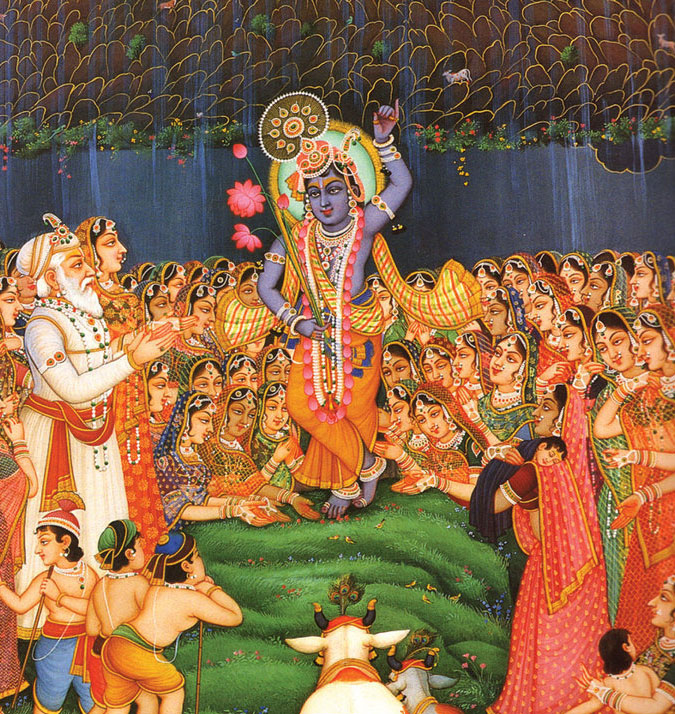
Young Krishna lifted the mighty Govardhana mountain to protect the people from torrential rains caused by Lord Indra (see picture);

The mighty Hanuman is said to have carried the huge Sanjeevi mountain with medicinal plants to revive Lakshmana in Lanka

There are many such miracles powered by faith in the current Kali Yuga. Here are some examples:

The massive Nandi (bull) installed in front of Lord Shiva in Chidambaram temple in Tamil Nadu is said to have moved to provide unobstructed Darshan (view) to faithful Devotee Nandanar from the low caste.

A Jain King sought to punish Appar (Tirunavukkarasar) for being a devotee of Lord Shiva. He tied Appar to a huge stone and threw him in deep waters. Appar floated because of his absolute faith in the efficacy of ‘Nama Sivaya’ manthram.

Oh…I can hear some of you say, “What you quote are all some age-old stories. How can we believe them?  Do you know of any such faith-driven miracles in recent times?”

Yes, positively yes! I know of people who have experienced the vanishing of ‘mountain-like’ huge problems because of the incredible power of faith - and people includes me too. Faith provided me the hope to survive amidst heavy odds in life and spring back. Just google - you will find countless stories of personal experiences narrated in the internet media.

Is there any scientific proof to uphold the power of faith? After all, what is science? It is simply accumulated knowledge based on human observation. No one observed the creation of the universe. It is simply a matter of implicit faith.
Want to know more on how scientific research has given the faithful reasons to rejoice? Take a look at Ari N. Schulman's article titled, “Does Faith Make You Healthier?” in the Wall Street Journal of August 9, 2013. I hope the following link works. If it does not, try cutting and pasting it on your browser.

In my May 2006 posting, I had quoted Sri Sri Ravishankar describing Faith or shraddha as one of the six types of wealth. He said, "Faith is needed when you have found the limit of your knowing... Your willingness to know the unknown is shraddha." It would be fanaticism to think there is nothing beyond. Absence of faith is doubt -- in yourself, others, or the whole. Ninety nine per cent of people doubt the whole, because they do not believe that there is a whole that is functioning."   

One has to really experience the incredible power of faith. Try building faith in the Unknown!